- Home
- Grapegrowing & Winemaking
- Planting material
- Grapevine breeding
Grapevine breeding
Developing grapevines for Australia’s future
Grapevine breeding develops new varieties and rootstocks with characteristics that can help Australian vineyards respond to changing production conditions, pest and disease pressures and a changing climate.
Wine Australia has a long-standing research partnership with CSIRO focused on developing and evaluating improved grapevine material for Australian conditions. Current research includes mildew-resistant winegrape varieties, rootstocks with durable pest resistance and improved salinity tolerance, and gene-editing technologies that could introduce desirable traits into existing premium winegrape varieties.
Together with evaluation, germplasm management and access to healthy, true-to-type planting material, this research is intended to provide the sector with a broader range of planting options for future vineyards.
Grapevine breeding in Australia
Australia has a long history of grapevine breeding and evaluation.
Key achievements in grapevine breeding in Australia
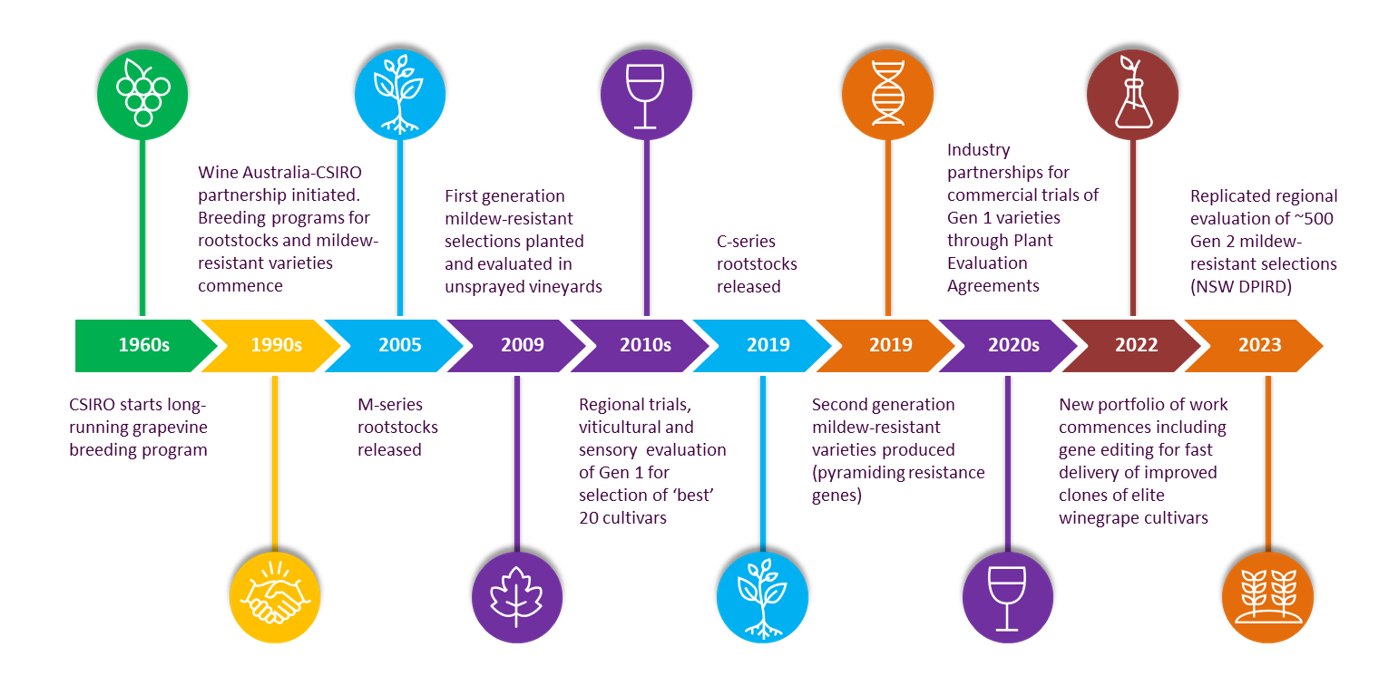
CSIRO began winegrape research in the 1960s at Merbein in Victoria. Its work included importing grapevine varieties, clones and rootstocks and establishing a diverse germplasm collection. Over subsequent decades, breeding and selection programs investigated thousands of breeding lines to develop wine, table and dried grape varieties suited to Australian growing conditions.
Early winegrape breeding focused particularly on performance in warm irrigated regions and characteristics such as colour, acidity, flavour and wine style.
A number of winegrape cultivars were released through this program:
| Variety | Year of release | Link |
|---|---|---|
Tarrango | 1975 | |
Taminga (W) | 1982 | |
Cienna | 2000 | |
Rubienne | 2000 | |
Tyrian | 2000 | |
Mystique | 2017 |
The CSIRO germplasm collection at Irymple, Victoria, remains an important industry asset and contains a substantial diversity of grapevine material.
Breeding for pest and disease resistance
More recent breeding has placed greater emphasis on improving the resilience of grapevines to some of Australia's major vineyard threats.
Wine Australia's co-investment with CSIRO has supported the development of winegrape varieties with resistance to powdery and downy mildew. This work produced around 1,200 first-generation mildew-resistant plants, from which leading red and white selections were progressed through further evaluation.
First-generation selections have been available for larger-scale industry field trials since 2019. Current work is focused not only on evaluating their performance, but also on addressing the practical pathway from research material to propagation and commercial use.
Second-generation material is also being evaluated. These vines combine multiple resistance genes with the aim of providing more durable resistance than first-generation material. More than 500 individual Gen 2 vines are currently undergoing field evaluation at Griffith and Orange in NSW.
Developing better rootstocks
Breeding is not limited to the fruit-producing part of the vine. Rootstocks are another major area of research.
Current Wine Australia and CSIRO research is developing second-generation rootstocks with durable resistance to phylloxera and root knot nematodes, together with improved salinity tolerance and traits that could increase resilience under changing Australian growing conditions.
This research complements the wider work to give growers access to healthy, true-to-type planting material and a greater choice of material suited to different vineyard conditions.
Gene editing and the next generation of grapevines
New breeding technologies provide additional ways of improving grapevines.
Alongside conventional breeding, Wine Australia is investing with CSIRO in the development and application of gene-editing technology for winegrapes.
Gene editing enables small, targeted changes to the grapevine genome and can achieve breeding outcomes with greater speed and precision than traditional breeding.
Current research with CSIRO is developing DNA-free gene-editing technologies and investigating their application to existing premium winegrape varieties. Rather than necessarily creating an entirely new variety through conventional crossing, this research is investigating specific genetic changes associated with production, disease or quality characteristics.
Why this matters for growers
The aim is to develop improved clones of existing winegrape cultivars while retaining the characteristics of established varieties.
A gene-editing pipeline for improved clones of elite winegrape cultivars has been developed, and further gene targets have been identified based on priority traits determined in collaboration with the sector.
For growers and viticulturists, this research is relevant to the longer-term development of planting material with improved characteristics, including fungal pathogen tolerance and other priority traits.
More than 200 gene-edited grapevine lines are currently being maintained within the research pipeline. These remain research material rather than commercially released grapevines.
Gene editing and genetic modification
Gene editing makes small, targeted changes to the grapevine genome that can be indistinguishable from naturally-occurring mutations.
The regulatory treatment of gene-edited material is an important area requiring careful explanation. For information about the current definitions applying to genetically modified food, refer to the relevant regulatory authority.
Improving confidence in the identity of Australia’s grapevines
Reliable identification of grapevine varieties and clones helps ensure growers and the propagation sector have access to true-to-type planting material. This is particularly important for older grapevine accessions, where records tracing material back to its origin may be incomplete or unreliable.
Traditional grapevine identification, known as ampelography, relies on visually examining a vine, particularly its leaves. DNA testing has now largely superseded this approach.
Using DNA to identify grapevine clones
For more than a decade, Wine Australia has funded research at the Australian Wine Research Institute (AWRI) to enable grapevine clones to be identified through DNA analysis.
The method combines next-generation genome sequencing, high-performance computing and customised bioinformatics.
The complete database contains more than 800 sequences and enables clonal typing of the majority of grapevine varieties and clones of economic importance in Australia, including:
- Shiraz
- Chardonnay
- Riesling
- Pinot Noir
- Cabernet Sauvignon.
This work supports Wine Australia’s strategic priority to facilitate the supply of clean, true-to-type planting material and protect Australia’s grapevine genetic resources. It also contributes to the development of information about the identity, location and health of Australian grapevine propagation assets.
Investigating Australia’s ancestral grapevines
In 2024–25, the DNA identification technique was applied to uniquely Australian heritage grapevine germplasm, with a focus on ancestor vineyards planted before 1900.
More than 300 individual vine samples were collected from 53 sites across eight geographical indications (GIs) in South Australia, Victoria and New South Wales, covering seven grape varieties.
The research will provide insights into the origins of Australia’s unique plantings and indicate how this heritage material relates to planting material that is commercially available today.
Read more about the project in this R&I News article
Grapevine clonal identification service
Following a successful beta-testing phase using samples of known or suspected identity from the propagation sector, the AWRI launched a commercial service for clonal identification of grapevine material.
Find out more about the Grapevine Clonal Identification Service