




Sparkling wine production
Understand the opportunities and demands of sparkling wine
Don’t underestimate the sparkling wine category: its opportunity, complexity, range of styles, compliance and technical demands. Success — as with all wines — demands a thorough understanding of all aspects, from vineyard to glass, as well as where, how and why it differs from the still wine category. This also includes how it is positioned and promoted.
The business opportunity for sparkling wine across price points, styles and occasions continues to attract attention as an increasing number of market insights from across the world consistently point to its growth as part of a durable, long-term shift in consumer purchasing behaviour.
How to find the right sparkling wine opportunity for your business
Few wine categories have a growth story to match sparkling wine.
Wine Australia’s Domestic and Export dashboards provide market and consumer insights that can help producers ask — and in some cases answer — the right business questions. Drawing on the latest data, the dashboards can help identify where potential opportunities for your business could lie, from style to price point and market.
Wine Australia’s Market Bulletin on sparkling wine sales (2024) also explores global data and insights relating to the size and spread of the sparkling opportunity. It provides a number of business considerations and key points, including:
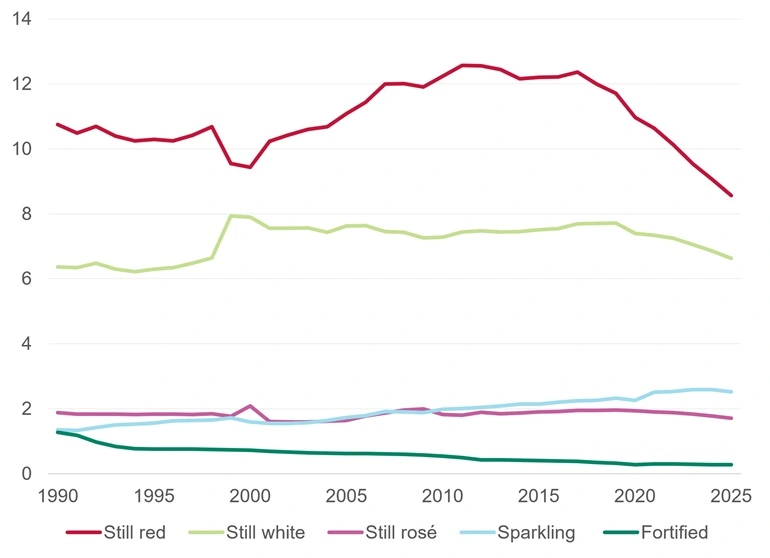
- Its growth over the last two decades (+5% per annum) has outperformed still wine (+2% per annum)
- The growth has been incredibly consistent over that same period (Figure 1)
- Unsurprisingly, the UK and USA are the primary importation markets but there are also very attractive opportunities in some smaller countries (Figure 2)
- For its population, Australia is a very solid market for sparkling wine
- The $20-$30 bottle price range has been growing particularly strongly
Figure 1: Global sales of sparkling wine (Source: ISWR)
Another publication that highlights the growth of the sparkling wine category is the State of the Grapes report (2025): a collaboration between Wine Australia and Endeavour Group. Insights from it were presented at Wine Australia's 2025 Global Market Update. You can watch the presentation below.
Which sparkling wine method should you choose?
The technical demands of sparkling wine are often stricter than for many other styles and, as always, the Wine Australia-funded AWRI Helpdesk is on hand to offer advice.
Technical considerations are only one part of the decision-making process. Method selection also has implications for cost structure, turnaround time, sensory profile, packaging format, legal description and the price point needed to make the product commercially viable.
Most winemakers are familiar with the basics of the different methods of making sparkling wine. The table below summarises what are usually considered the key business strengths and weaknesses of each of the three main methods.
Table 1: Overview of main sparkling methods
| Traditional | Charmat | Carbonation |
|---|---|---|
Advantages | ||
|
|
|
Challenges | ||
|
|
|
Traditional method remains, unsurprisingly, the leader when it comes to the highest quality sparkling wines in the world but that comes at a price. It is only the relatively large sites that can make use of the economies of scale offered by robotics. For most businesses it is quite expensive, so diligent financial modelling is required.
Charmat method is often (not always) where small to medium sized wine businesses can start to see an alignment between input costs and ex-winery sale price.
Carbonation is generally the simplest method but still has its own technical demands, the most obvious being the slightly lower final alcohol level compared with secondary fermentation methods. An often-overlooked consideration is the precise terminology and labelling requirements. Wine Australia’s Additional labelling terms is a useful resource and guide and notes that carbonated wines should not be labelled as ‘sparkling’.
Other sparkling wine production methods can be appropriate in the right product context, but generally require a clearer understanding of stylistic trade-offs, operational constraints and compliance risk. In practice, these products often become niche not because they lack merit, but because consistency, stability, scale or category clarity can be harder to maintain. Ancestral or Pétillant Naturel (Pét-nat) wines can be very tricky to make with consistency and sometimes have major challenges with basic stability. The Transfer Method has its own challenges but can also be a great fit for some products, mostly in larger businesses. Undoubtedly, spritz and no and low alcohol products also present significant opportunity and have their own very specific technical challenges. Makers of these products will benefit from a review of Wine Australia’s Additional labelling terms, especially the section on ‘Lawful use of the word ‘wine’’.