


Indonesia
Indonesia is the largest economy in Southeast Asia and the International Monetary Fund has projected it to be the world’s seventh largest economy by 2030. With a population of 284 million people, Indonesia is the fourth most populous country in the world. The population has become increasingly urbanised, with the share of those living in urban locations growing from 30 per cent in 1990 to 59 per cent in 2024.
Indonesia’s middle class is booming, estimated at 45 million people, and with a GDP exceeding one trillion dollars it is a market with significant economic potential. By 2030, the middle class population is estimated to reach 54 million. Indonesia’s young population is driving demand for international brands and imported products, and this has fostered opportunities for premium wine.
Indonesia is a predominantly Muslim country and alcohol cannot be consumed under Islamic law. While in general, Indonesians are fairly tolerant towards alcohol, alcohol sales and distribution are strictly controlled, and excise duties are high. The Indonesian government appoints importers of alcoholic drinks. There are now over 18 importing companies established in the market and thus building relationships with the importers is crucial.
Alcoholic drinks with an ethanol content greater than 5 per cent may only be retailed and consumed through hotels (3, 4 and 5 star), specified restaurants, bar/pub/night clubs, duty free shops or certain places assigned by a mayor of the district.
Wine consumers include urban, wealthy, well-travelled and middle-income Indonesians, the expat community, and tourists.
The rapidly rising middle class has been incorporating wine into their lifestyles, particularly in Jakarta and Bali. The influence of foreign visitors, an increase in Western education and the appeal of Western lifestyles have been attributed to the growing trend. Owing to its strong tourist trade, Bali accounts for the highest volume of wine sales in the region. Although 2023 marked a return to normality post-pandemic, the tourism industry did not fully recover, with foreign visitors at 73 per cent of the 2019 levels. Tourist arrivals in Bali surged but still fell short, at 84 per cent of 2019 levels.
Indonesia and Australia are parties to two free trade agreements; the ASEAN-Australia-New Zealand Free Trade Agreement (AANZFTA) which came into force in January 2010; and the Indonesia-Australia Comprehensive Economic Partnership Agreement (IA-CEPA) which entered into force on 5 July 2020. However, wine has been excluded from Indonesia’s tariff commitments under both agreements and thus there is no preferential rate applied on Australian wine.
Despite the challenges and representing only 3 per cent of total alcohol consumption, a dynamic and growing wine scene exists in Indonesia. According to IWSR, after being hit hard in 2020 due to the COVID-19 pandemic, the wine market has gradually recovered in the last three years to reach 760,000 cases valued at US$217 million in 2023 (see Figure 1). While this is lower than the market size in 2019, IWSR have forecast the growth of 6 per cent per annum in the five years to 2028, despite inflationary pressures impacting on the market in 2024.
Figure 1: Volume and value of wine consumption in Indonesia over time
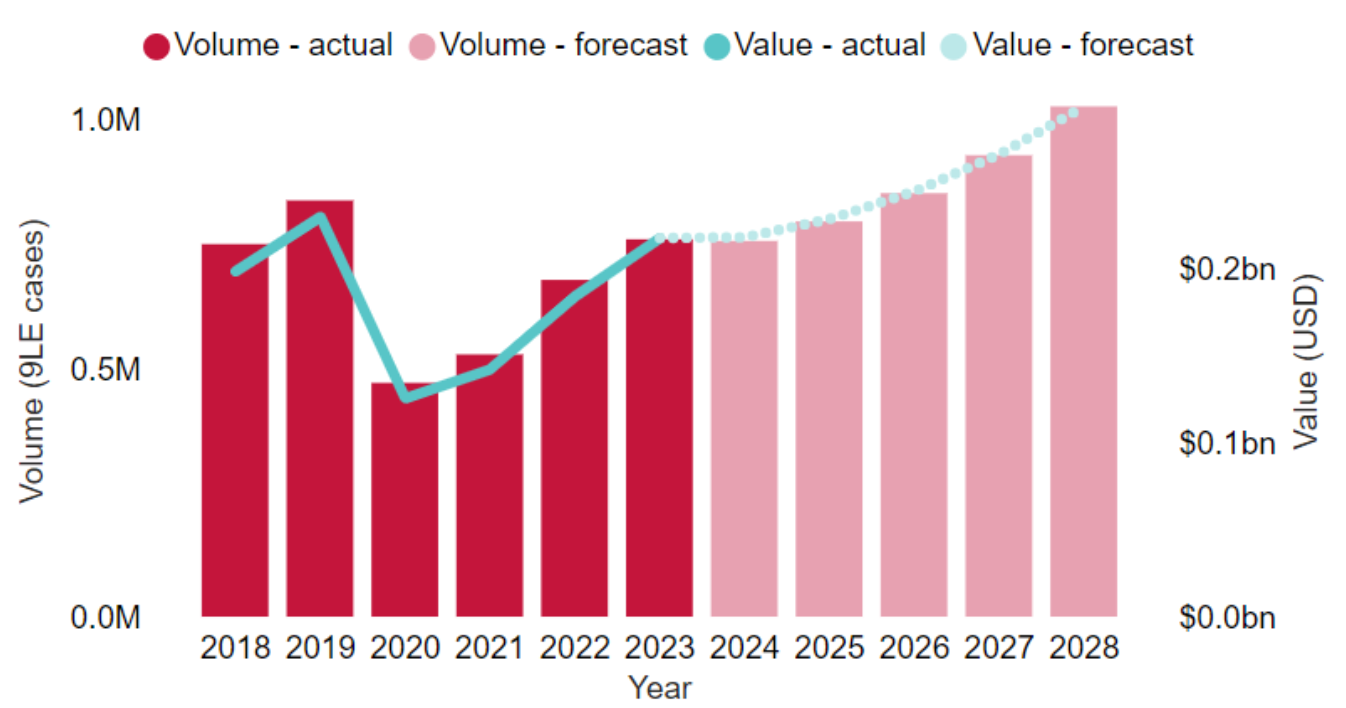
Source: IWSR and Wine Australia Market Explorer
Indonesia has a significant domestic wine sector with local wines accounting for just over 60 per cent of wine consumption. However, the share of local wines has been falling since 2019. In contrast, since the pandemic, imported wines have increased their market share from 30 per cent in 2019 to 38 per cent in 2023.
Australia is well-placed in Indonesia, ranked the number one imported wine category in the market with a 34 per cent share in 2023. The main international competitors for Australia are Chile, New Zealand, France and Argentina.
Given the emerging nature of the market, it is unsurprising that Australian exports to Indonesia have been relatively volatile in recent years (see Figure 2).
Figure 2: Australian wine exports to Indonesia over time
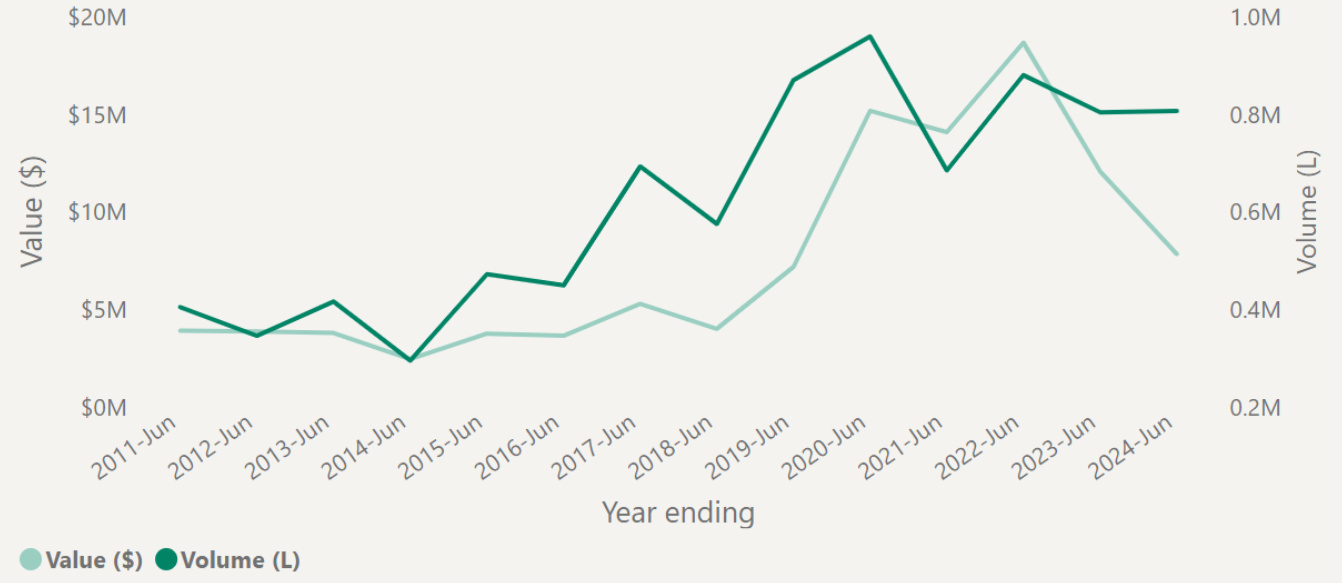
Source: Wine Australia Export Dashboard
In the 12 months ended June 2024, Australian exports to Indonesia increased marginally in volume to just over 800,000 litres but value declined by 35 per cent to A$8 million. The decline in value came mostly in exports of Cabernet Sauvignon priced at A$10 or more per litre. Three-quarters of the exports to Indonesia were still red wines and just over 20 per cent still white wines with the rest sparkling and other wine styles.
In the last 12 months, 59 Australian businesses exported to Indonesia, with 17 new to market and 8 from the previous year ceasing exports.
Philippines
The Philippines is an important trade and investment partner for Australia, with the Philippine economy growing at an average of six per cent per year – one of the fastest growing economies in Asia. Australia's proximity to the Philippines and its reputation as a supplier of quality materials and services are important factors enhancing the bilateral trade, economic, and investment relationship with a market of 113 million people. The population is forecast to grow to 140 million by 2045. Currently, the population of the Philippines is relatively young with 59 per cent under the age of 25.
The Philippines is one of the most westernised in Asia due to its history of foreign occupation. The Philippines endured over 300 years of Spanish rule from the 16th century, ending in 1898. The Spanish occupation introduced Roman Catholicism to the Philippines which is still the major religion of the country. The Philippines was then occupied by the United States who introduced English. After being occupied by the Japanese during the Second World War, the American granted full Independence to the island nation on 4 July 1946.
Filipinos are heavy users of the internet with 74 per cent of the population using the internet and over 80 million users of social media. The digital economy in the Philippines is valued at US$20 billion and forecast to grow to US$100 billion by 2030. And in time spent using mobile internet, the Philippines is ranked first globally.
Under the Australia – New Zealand Free Trade Agreement (AANZFTA) and Regional Comprehensive Economic Partnership (RCEP), Australian wine is tariff-free in the Philippines. There are around 20-30 wine importers/ distributors in the Philippines and retailers can also conduct direct importation of wine. Currently 58 Australian companies export wine to the Philippines, with 33 ceasing to export to the country and 11 commencing in the 12 months to June 2024.
The Philippines wine market is the fifth largest In Southeast Asia. Wine is a very small category, accounting for only 0.5 per cent of total alcohol consumption. Beer is very much the dominant beverage in the country. Wine is considered a drink of higher-income consumers as well as tourists and foreign expats. While males currently account for the majority of purchases, there is a growing market for females and younger professionals.
Like most markets in the region, the COVID-19 pandemic negatively impacted on wine consumption and while showing some signs of improvement, consumption in the Philippines has not yet returned to 2019 levels (see Figure 3). The IWSR has forecast that the volume of wine consumption in the Philippines will not return to those levels until 2030. On the other hand, value growth is much stronger and is already at 2019 levels. In 2023, the wine market was valued at US$171 million, while volume totalled 1.7 million cases.
Figure 3: Volume and value of wine consumption in Philippines over time
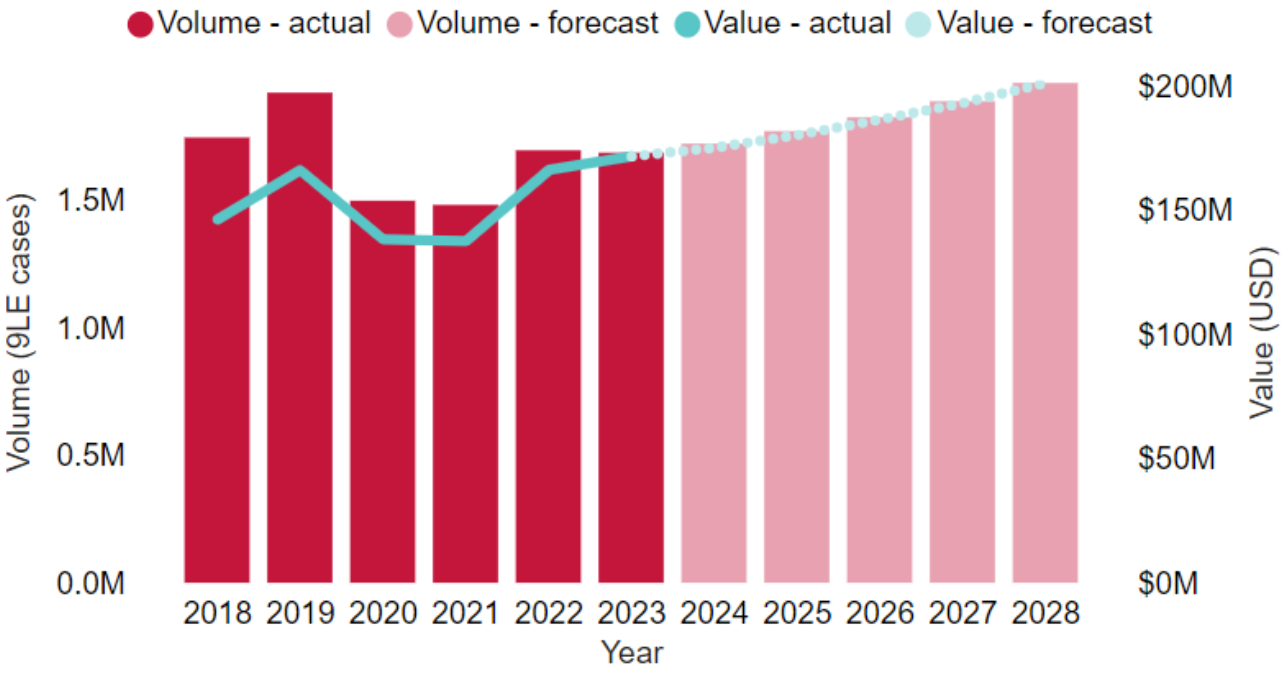
Source: IWSR and Wine Australia Market Explorer
The market is dominated by imported wines with an 82 per cent volume share in 2023. With a 15 per cent share of imported wine consumption, Australian wine is ranked second behind the United States. The historical ties to the US are a contributing factor in their top ranking.
After a dip related to the pandemic, an upward trend in Australian wine exports has resumed over the last few years (see Figure 4). Like many emerging markets in Southeast Asia, there has been some volatility from year to year. In the 12 months ended June 2024, the volume of Australian wine exported to the Philippines declined by 2 per cent to 2.6 million litres and value fell by 19 per cent to A$13.7 million. These figures are still well above pre-pandemic levels. Similar to Indonesia, the decline was most significant in Cabernet Sauvignon priced at A$10 or more per litre. Two-thirds of Australia’s exports is still red wine, with just over 20 per cent sparkling wine and 14 per cent still white wine. Philippines is the eighth biggest destination in value for Australian sparkling wine exports.
Figure 4: Australian wine exports to Philippines over time
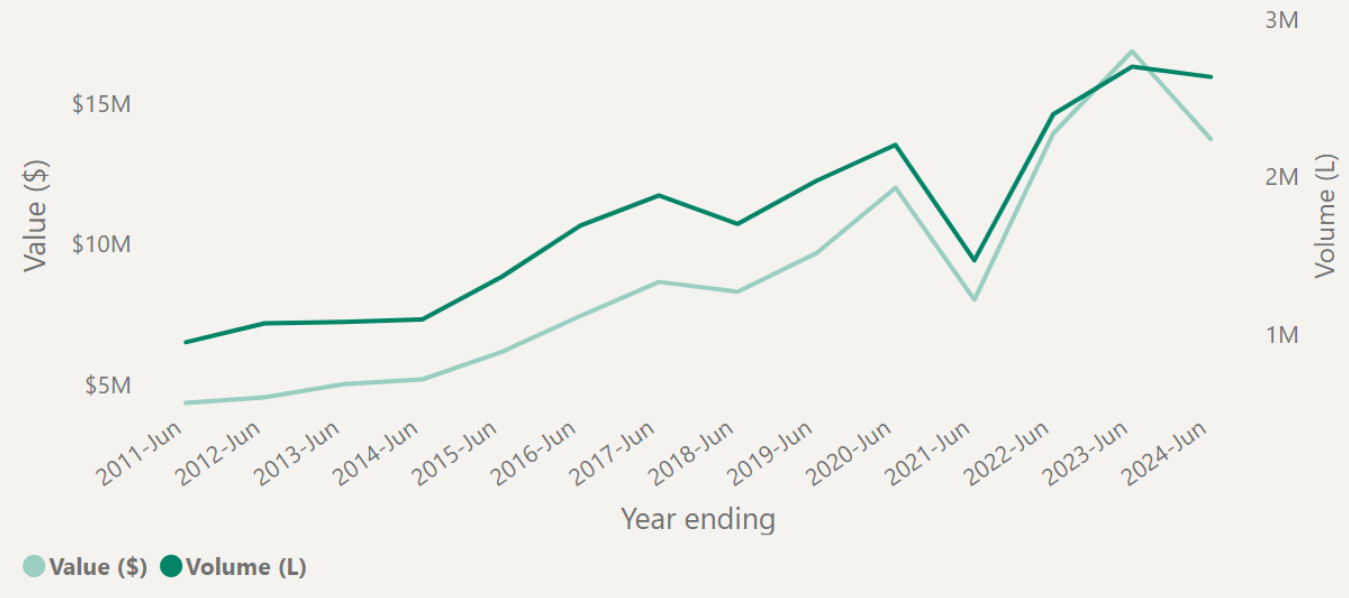
Source: Wine Australia Export Dashboard
For more information on Indonesia and the Philippines please refer to:
-
Export market guide

Indonesia Export Market Guide
Compliance information for exporting wine to Indonesia, including the regulatory environment, importing requirements, and key government contacts.
-
Export market guide

Philippines Export Market Guide
Compliance information for exporting wine to Philippines, including the regulatory environment, importing requirements, and key government contacts.
-
Market report
Export Market Development Guidebooks: key Asian markets
-
Dashboard or calculator

Market Explorer
Explore wine consumption statistics, trends, and key economic indicators for the top 40 most attractive wine markets
-
Dashboard or calculator

Export Dashboard
Comprehensive data on Australian wine exports back to 2010 including market, container type, wine style, GI and variety label claim and price segment.