


Powdery mildew
Recognising powdery mildew
Powdery mildew is identified by its characteristic grey-white powdery growth on infected plant tissue.
Symptoms on leaves
Early symptoms can be difficult to detect and often include:
- Irregular yellow-green spots or blotches on upper leaf surfaces.
- Browning of small veins on the underside of leaves, particularly in Chardonnay.
- Grey-white powdery fungal growth as infections develop.
- Distorted or upward-curled young leaves in severe infections.
- Dark web-like markings on leaves where powdery growth has rubbed off.
To improve detection, inspect leaves from different angles. Early mildew colonies are often easier to see when the leaf is tilted towards the light.
Symptoms on shoots and canes
Early-season infections may produce:
- Stunted flag shoots with curled or distorted leaves.
- Grey-white powdery growth on young tissue.
- Red-brown patches on older shoot infections.
- Poor or uneven cane lignification.
- Red-brown to black web-like markings on mature canes.
- Tip dieback or shoot death in severe infections.
Flag shoots indicate infected buds from the previous season and can be an important source of early-season inoculum.
Symptoms on bunches and berries
Bunches are most vulnerable from flowering through to early berry development. As berries mature, they become less susceptible to infection, although bunch stems can remain susceptible.
Symptoms may include:
- Grey-white powdery growth on berries and bunch stems.
- Distorted, scarred or split berries.
- Uneven colouring in dark-skinned varieties.
- Reduced fruit quality.
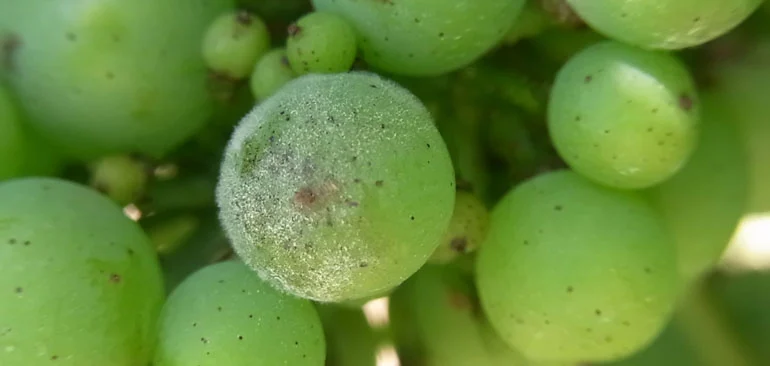 Powdery mildew on a berry
Practical management strategies
Successful powdery mildew management combines regular monitoring, canopy management and timely fungicide use. Prevention is critical, as disease becomes much more difficult to manage once established.
Monitor regularly
Regular monitoring is essential for early detection and effective control.
As a general guide:
- Monitor every two weeks from budburst.
- Monitor weekly from flowering to fruit set.
- Monitor every two to three weeks during late season and after harvest where practical.
When monitoring:
- Inspect multiple locations within each block.
- Focus on previous disease hot spots.
- Check both inner-canopy and exposed leaves.
- Inspect bunches closely between flowering and fruit set.
- Mark and record infected areas to support future management decisions.
Early detection improves management options and helps prevent disease spread.
Monitoring tools
PMapp is available for Apple devices and can assist with powdery mildew identification, bunch assessment and estimating disease severity.
For additional information, visit the online powdery mildew resource.
Act early
Stopping powdery mildew from becoming established early in the season is one of the most effective ways to reduce disease pressure later in the year.
Early intervention can:
- Protect leaves, shoots and bunches during key growth stages.
- Reduce the risk of bud infection.
- Limit the build-up of inoculum within the vineyard.
- Reduce disease pressure in the following season.
Blocks with a history of powdery mildew, sheltered sites and susceptible varieties should be prioritised for monitoring and management.
Maintain an open canopy
Canopy structure has a major influence on disease risk and fungicide performance.
Good canopy management can:
- Improve airflow through the canopy.
- Increase sunlight and UV light penetration.
- Reduce humidity around bunches and shoots.
- Improve spray penetration and coverage.
- Create less favourable conditions for disease development.
Practices such as shoot thinning, shoot positioning and managing vine vigour can help maintain an open canopy throughout the growing season.
Prioritise spray coverage
Effective fungicide programs depend on applying the right product at the right time and achieving good spray coverage.
For best results:
- Apply fungicides before disease becomes established.
- Maintain recommended spray intervals during periods of high disease pressure.
- Ensure spray reaches bunch zones, inner-canopy leaves and other shaded areas where disease commonly develops.
- Adjust application techniques and spray patterns throughout the season as canopy density changes.
Good coverage is particularly important because powdery mildew frequently develops on protected plant surfaces that can be difficult to reach.
Manage fungicide resistance
Fungicide resistance can reduce the effectiveness of disease control options and make powdery mildew more difficult to manage.
To help minimise resistance:
- Rotate fungicides from different mode-of-action groups.
- Follow label directions and resistance-management recommendations.
- Use fungicides as part of an integrated program that includes monitoring and canopy management.
- Avoid relying repeatedly on the same fungicide group.
- Investigate suspected fungicide failures and seek technical advice where required.
Integrated disease management helps preserve the effectiveness of fungicides and supports more sustainable powdery mildew control over the long term.
Fungicide resistance resources
AWRI fungicide resistance resources
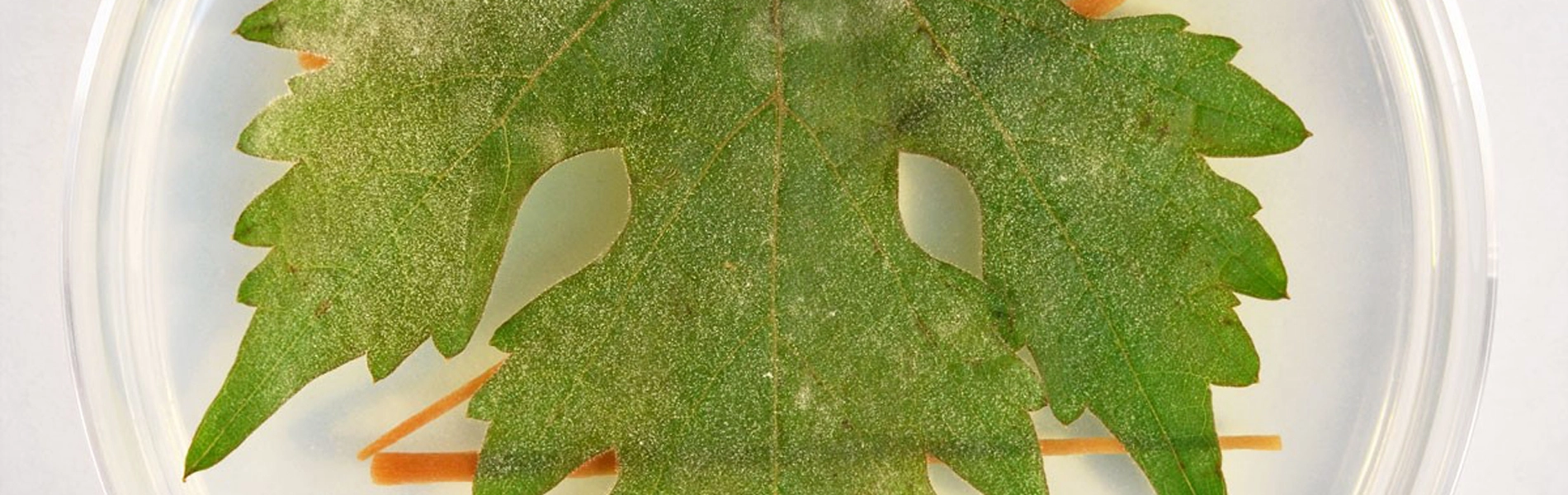 Phenotypic Fungicide resistance testing
Late-season management
Late-season powdery mildew control can be difficult, particularly once disease has become established within a dense canopy. Management outcomes depend heavily on canopy access and spray coverage.
If powdery mildew is detected late in the season:
- Assess and record affected areas.
- Contact the winery or grape purchaser about relevant fruit specifications.
- Check withholding periods and product label directions.
- Improve canopy openness where practical.
- Seek technical advice about protecting healthy foliage and managing risk for the following season.
Continue monitoring after harvest where practical, particularly in blocks with known infection, to identify disease hot spots and support planning for the following season.
Prevention and early-season control remain the most effective ways to reduce powdery mildew.
-

Eutypa dieback and grapevine trunk disease
Grapegrowers -

Downy mildew
Grapegrowers -

Mealybugs
-

Non-botrytis bunch rots
-
Grapevine viruses
-
Phylloxera
-

Phomopsis cane and leaf spot
-

Botrytis bunch rot
Grapegrowers -
Nematodes in vineyards
-
Light brown apple moth
-

Grapevine Pinot Gris virus
Grapegrowers -
Grapevine scale and sooty mould