


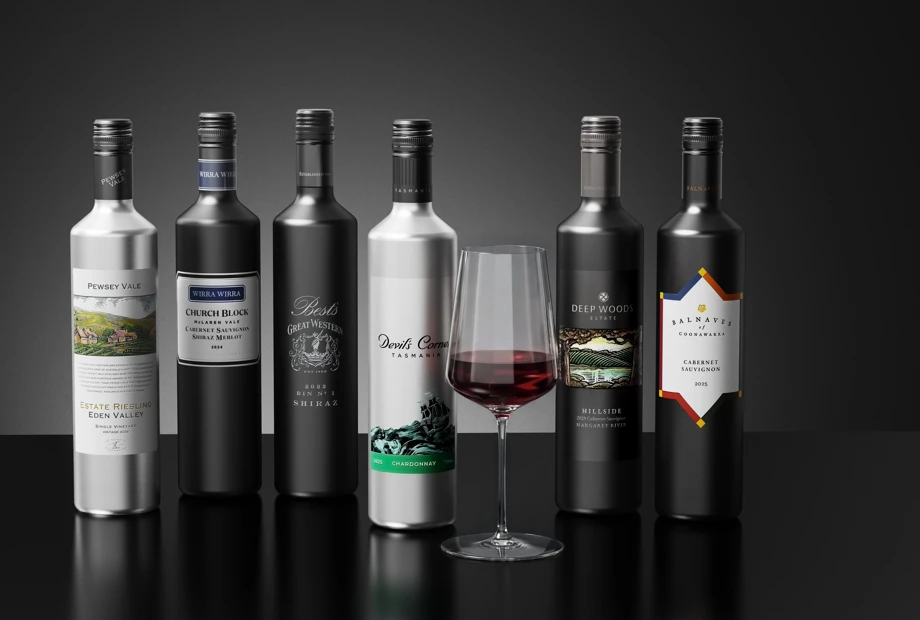
An Australian-developed stainless steel wine bottle is undergoing further evaluation with support from some of the country’s leading wine businesses, as the company behind the innovation investigates its potential as a lower-emissions alternative to traditional glass packaging.
Hill-Smith Family Estates, Brown Family Wine Group, Fogarty Hall Fine Wine Estates, Wirra Wirra, Balnaves of Coonawarra and Best’s Great Western have agreed to support the proof-of-concept evaluation of the 150-gram EcoSteel bottle. Their involvement forms part of the broader assessment of the concept’s technical performance, environmental credentials and commercial viability.
The EcoSteel bottle is being developed by Wine One to address the carbon emissions associated with manufacturing and transporting heavy, single-use glass wine bottles. Packaging and transport are significant contributors to the wine sector’s carbon footprint, making alternative packaging an important area for emissions reduction.
This is particularly relevant for premium wine producers exporting to markets where carbon reduction, packaging requirements and environmental performance are becoming increasingly important considerations.
EcoSteel was one of two innovations selected to progress to the proof-of-concept phase of the Australian Government’s Business Research and Innovation Initiative (BRII), following feasibility assessments supported in-kind by Wine Australia.
Six packaging concepts initially received grants of up to $100,000 to test their technical and commercial feasibility. EcoSteel and Packamama’s polymer wine bottle subsequently progressed to proof of concept, with each receiving $1 million in Australian Government funding through BRII to further develop and test their proposed alternatives to traditional glass bottle.
Wine One’s Lloyd Fenn welcomed the involvement of the six Australian wineries, saying their participation demonstrated industry interest in exploring alternative packaging.
“The participation of these great Australian wineries shows their commitment to sustainability and innovation. But EcoSteel still needs to prove itself through independent technical testing and their support shouldn’t be taken as an endorsement of the bottle’s performance or a commitment to adopting it commercially.”
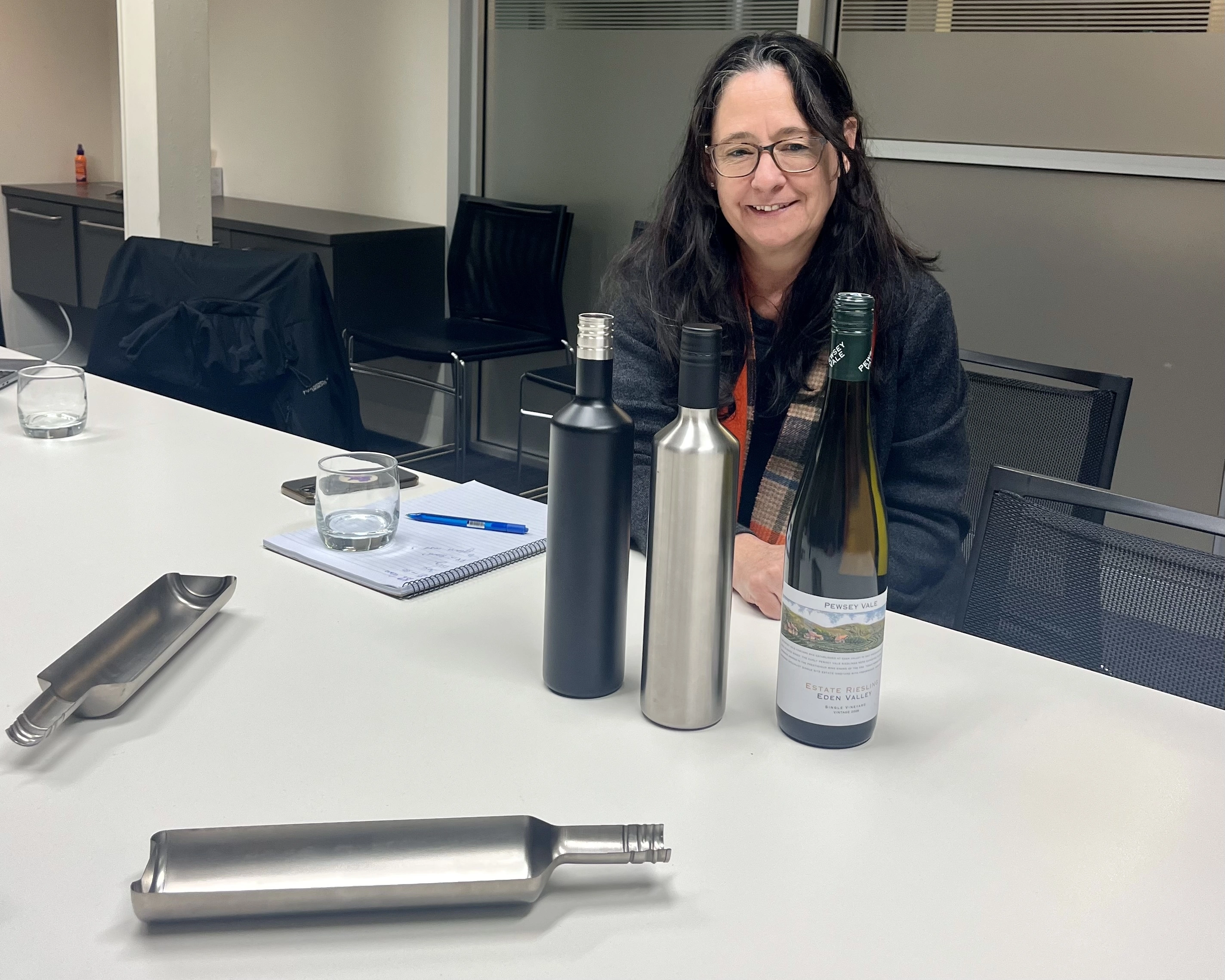 Louisa Rose with the EcoSteel prototype.
Louisa Rose, Head of Sustainability at Hill-Smith Family Estates, whose Pewsey Vale brand is participating in EcoSteel’s proof of concept, said: “For the wine industry to have a healthy future, this cultural product we love has to be kind to the planet and in step with those of us who want to see our natural environment thrive.
“We're committed to lessening its carbon footprint, and with packaging and shipping responsible for the vast majority of emissions, this is an obvious area to target.
“It's exciting to see Australia try to change the game, and it would be a huge step in the right direction if the ultra-lightweight EcoSteel bottle proves its technical, economic and environmental credentials to be a global-scale, viable alternative to glass,” she said.
As part of the ongoing proof-of-concept evaluation, Wine One has engaged Affinity Labs, the commercial arm of the Australian Wine Research Institute, to assess the prototype’s suitability as a long-term wine packaging solution.
A detailed Life Cycle Assessment is also nearing completion in conjunction with the University of Queensland. Lloyd Fenn said an earlier streamlined assessment undertaken during concept development indicated that the EcoSteel single-use format could have around one-third of the carbon footprint of a premium glass bottle.
The wines earmarked for the testing phase include Pewsey Vale Riesling from the Eden Valley, Devil’s Corner Chardonnay from Tasmania, Deep Woods Hillside Cabernet Sauvignon from Margaret River, Wirra Wirra Church Block Cabernet Sauvignon Shiraz Merlot from McLaren Vale, Balnaves Cabernet Sauvignon from Coonawarra and Best’s Bin No.1 Shiraz from Great Western.
As part of the ongoing proof-of-concept evaluation, Wine One has engaged an independent, NATA-accredited laboratory to assess the prototype’s suitability as a long-term wine packaging solution.