


Building on more than 10 years of research, the team at the South Australian Research and Development Institute (SARDI) and Charles Sturt University – with support from Wine Australia – is delivering new insights to help growers better protect their vines from grapevine trunk diseases (GTDs).
GTDs, such as Eutypa dieback, Botryosphaeria dieback, black foot and Petri disease, are some of the most serious threats to vineyard health and productivity.
The national research effort into GTDs in Australian vineyards and nurseries is enhancing knowledge of pathogen spread and early detection, ultimately helping growers manage them more effectively.
Key findings to date relate to how far spores from infected vines can travel, the susceptibility of pruning wounds to airborne spores, timing of applications of pruning wound protectant and threshold levels of infection in planting material. Progress is also being made in biological and natural control options for GTD pathogens.
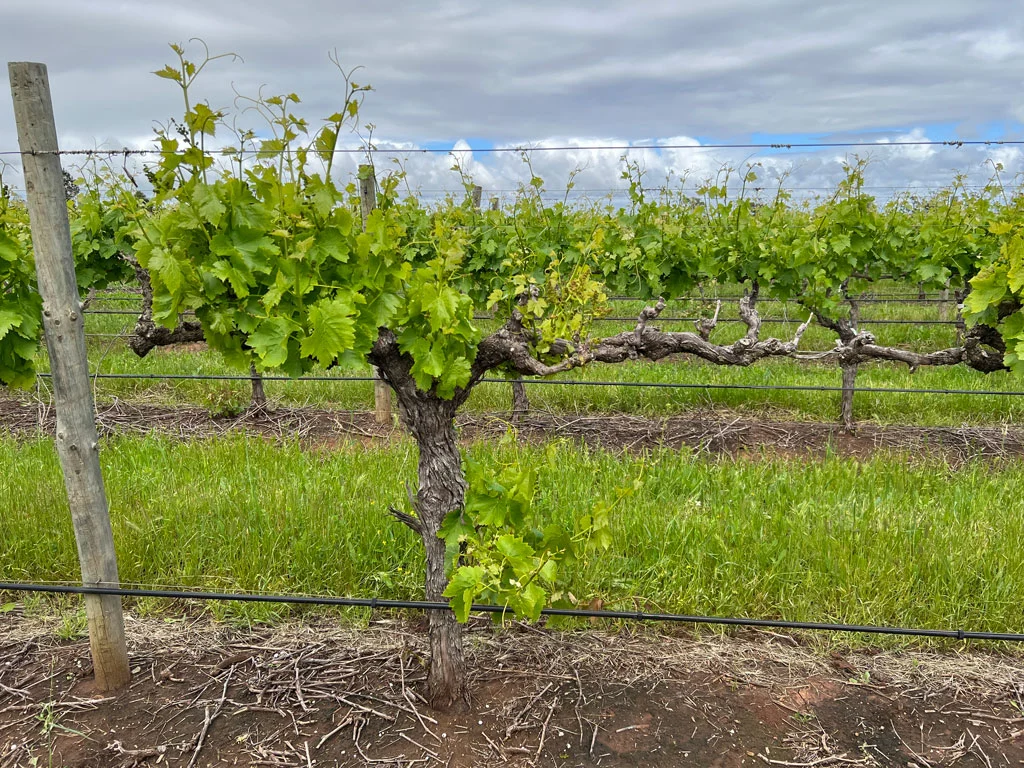 |
| Foliar symptoms of Grapevine Trunk Diseases may not develop until 3–8 years after infection and are often only apparent on one cordon of an infected vine. |
Spores travel far and land on pruning wounds
GTD pathogen spores can travel up to four kilometres from infected vines, particularly after rain and wind events. Even vineyards with no history of trunk disease may be exposed to inoculum carried from neighbouring blocks.
Vineyard experiments with simulated pruning wounds showed that larger pruning wounds are more likely to capture airborne spores during wet periods.
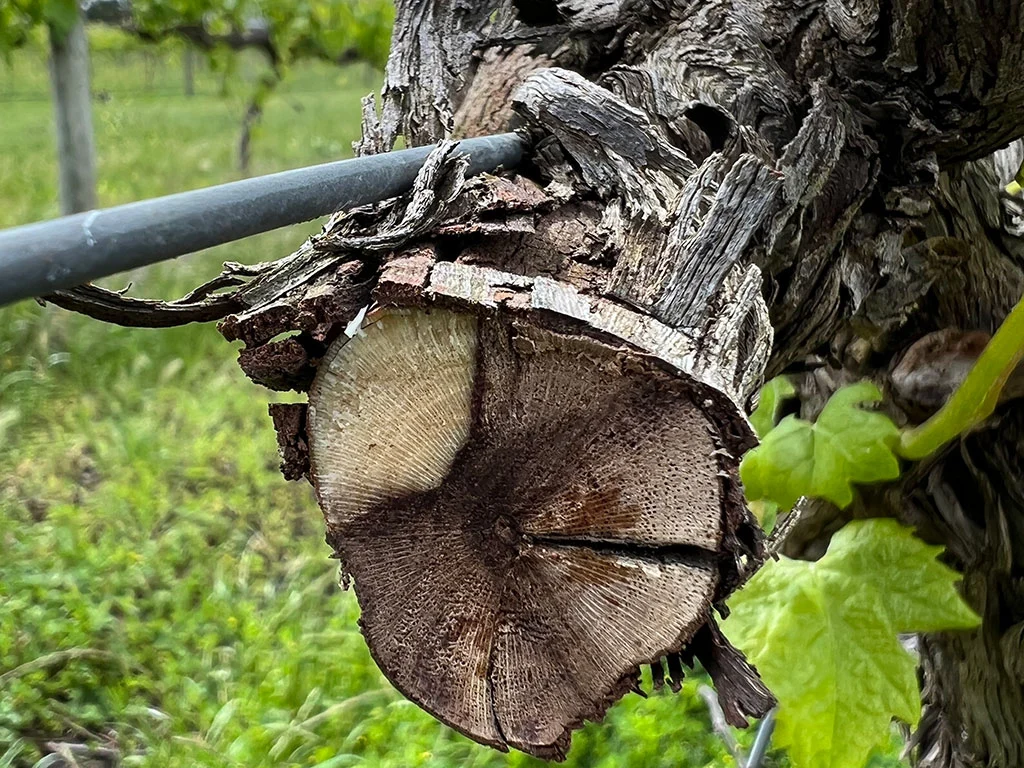 |
| A cross-section of a cordon showing dark brown, wedge-shaped zones of dead wood characteristic of Grapevine Trunk Disease. |
What does this this mean for growers?
To reduce the risk of infection, protect pruning wounds and try to time pruning for dry weather whenever possible.
Wound susceptibility depends on timing
Trials in Tasmania and Western Australia, in collaboration with the University of Tasmania and the Western Australian Department of Primary Industries and Regional Development, found that pruning wounds are most susceptible to infection within the first 7–14 days. However, susceptibility can extend for several weeks depending on region and timing of pruning. In some cases, mid-winter pruning wounds remained susceptible for up to 42–56 days.
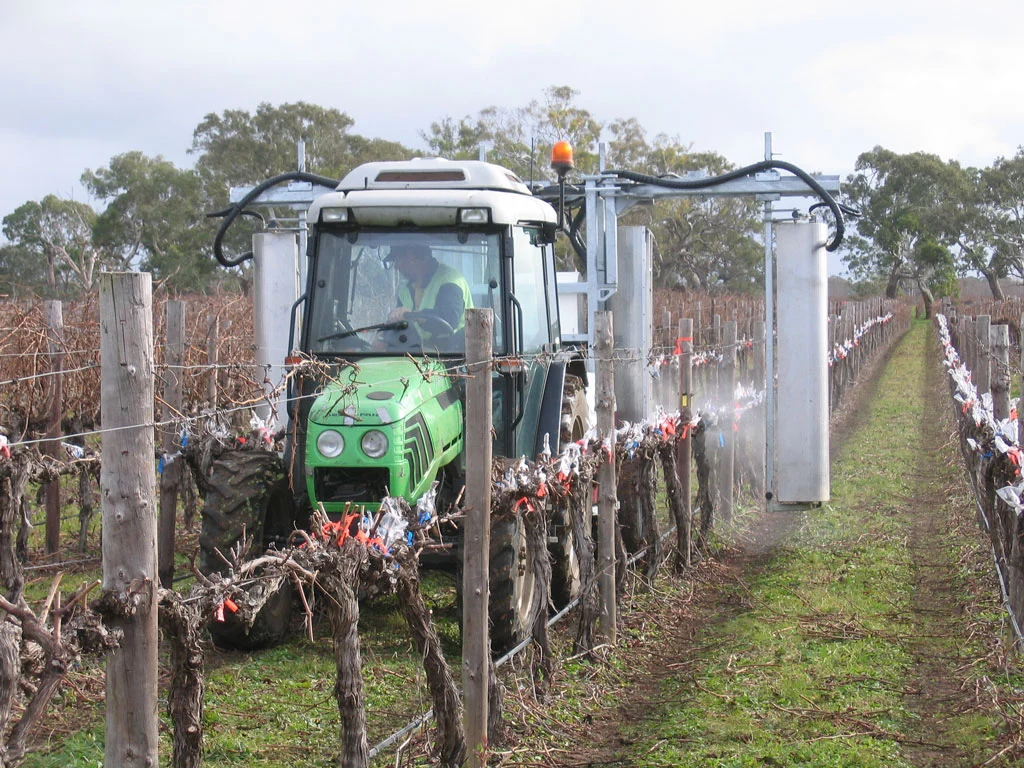 |
| Timely applications of pruning wound protectant are important in reducing the risk of infection from Grapevine Trunk Diseases. |
Trials also showed that spring shoot thinning wounds are susceptible to infection, with rough socket wounds, caused by tearing shoots, significantly more prone to infection than clean cuts.
Best practice
- Apply wound protection products as soon as possible after winter pruning.
- Avoid tearing shoots during spring shoot thinning – cut cleanly instead with sharp tools.
Planting material: defining infection thresholds
Recent testing of source blocks and nursery material has that GTDs and Young Vine Decline (YVD) pathogens can be present in propagation material, even in young, healthy-looking vines. Importantly, detection does not necessarily mean disease will develop. This distinction is critical as the likelihood of decline depends on many factors, including pathogen load, vine management and environmental conditions.
By defining infection thresholds – the levels of pathogen present that actually pose a risk – this work is equipping growers and the propagation sector with practical tools to manage planting material and support the healthy establishment of vines.
“The next step is to understand what these different levels of infection mean for the health of the plant within the first few years. This work will provide nurseries with more tools for ensuring healthy planting material," explains Dr Jared Hrycan, Postdoctoral Research Fellow at the Gulbali Institute, Charles Sturt University.
The bottom line
There is no such thing as perfectly clean planting material. What matters is understanding how much is too much and taking shared responsibility across the supply chain to reduce stress, protect wounds and give young vines the best possible start.
Growers can
- Follow best-practice vine establishment to reduce stress in young vines.
- Use wound protection from first pruning to give new vines the best start.
New tools for faster, more accurate diagnosis
This project is also delivering next-generation diagnostic technologies, including:
- qPCR and LAMP tests for rapid, accurate pathogen detection.
- Digital PCR (dPCR) for greater sensitivity in complex samples like wood, roots, or spore tapes.
- Multiplex testing for detecting multiple pathogens in a single sample.
Some of these tools are already in use in South Australia, with testing services available through SARDI Horticulture Pathology Diagnostics (+61 8 8429 2240, [email protected]). Rollout to other states is planned. Contact your local plant diagnostic laboratory to confirm availability in your region.
What does this mean for growers?
Early detection and better monitoring of vine health will make it easier to catch infections before symptoms appear, improving decision-making at both nursery and vineyard level.
Evaluating natural products and biocontrols
To help reduce chemical use, the project team is trialling a range of biological and natural compounds for their ability to prevent infection. These include:
- essential oils (e.g. clove, cinnamon, tea tree)
- organic acids (e.g. citric and boric), and
- biological agents such as Pseudomonas poae, Vinevax, Botector, and Serenade Prime.
Some early trials have shown promise, while others are being refined through repeat lab and field trials.
Why it matters
A move toward more sustainable trunk disease management is possible, but it takes time and rigorous testing to understand what works best, and under what conditions.
With trunk diseases posing a serious threat to vineyard longevity and sustainability worldwide, Australia’s wine sector is responding with smart science, practical innovation, and strong partnerships across the supply chain.
“This research is about giving nurseries and growers the tools and knowledge they need to make informed decisions. By working together - researchers, nurseries and growers - we can give our vines the best possible chance to stay healthy, productive and resilient for decades to come.”


