

Legibility (Standard 1.2.1–24)
There are no print size specifications under the Food Standards Code other than the general legibility requirements which requires any mandatory statement to be in English and be legible and prominent so as to contrast distinctly with the background of the label.
Date marking (Standard 1.2.5)
A best-before-date is mandatory on products with less than two years’ shelf life. The Food Standards Code defines the ‘best before’ date as
the date which signifies the end of the period during which the intact package of food, if stored in accordance with any stated storage instructions, will remain fully marketable and will retain any specific qualities for which express or implied claims have been made.
In the case of wine and wine product, this normally would only apply where plastic or other non-glass packaging is used and where a limited shelf life (less than two years) is likely. However, if the description and presentation of the wine claims or implies certain qualities (such as freshness, drink whilst young etc.) then a ‘best before’ date is required unless any such claims would remain valid for at least two years.
The date must appear in the format ‘best before [month] [year]’ e.g. ‘best before Dec 21’ or ‘best before 12 21’ and the label must include a statement of any specific storage conditions required to ensure the food will keep for the specified period.
Nutrition and health claims (Standard 1.2.7—4)
The Food Standards Code prohibits health claims and nutrition content claims for products containing more than 1.15% alcohol by volume, except for energy content claims, sugar or sugars content claims, carbohydrate content claims, and gluten content claims. This prohibition does not apply to the energy statement in the prescribed tabular format (refer to the energy statement section, mandatory from 13 August 2028).
A health claim is a claim that states, suggests or implies that a food, or a property of a food, has or may have a health effect. Nutrition content claims are about the presence or absence of nutrients or other substances, such as protein, sodium, vitamins, or biologically active substances (for example resveratrol, polyphenols or antioxidants).
Where any of the following nutrition content claims are made:
- an energy content claim (as distinct from the mandatory energy statement)
- a sugar or sugars content claim
- a carbohydrate content claim
a full Nutrition Information Panel (NIP) must be included on the label.
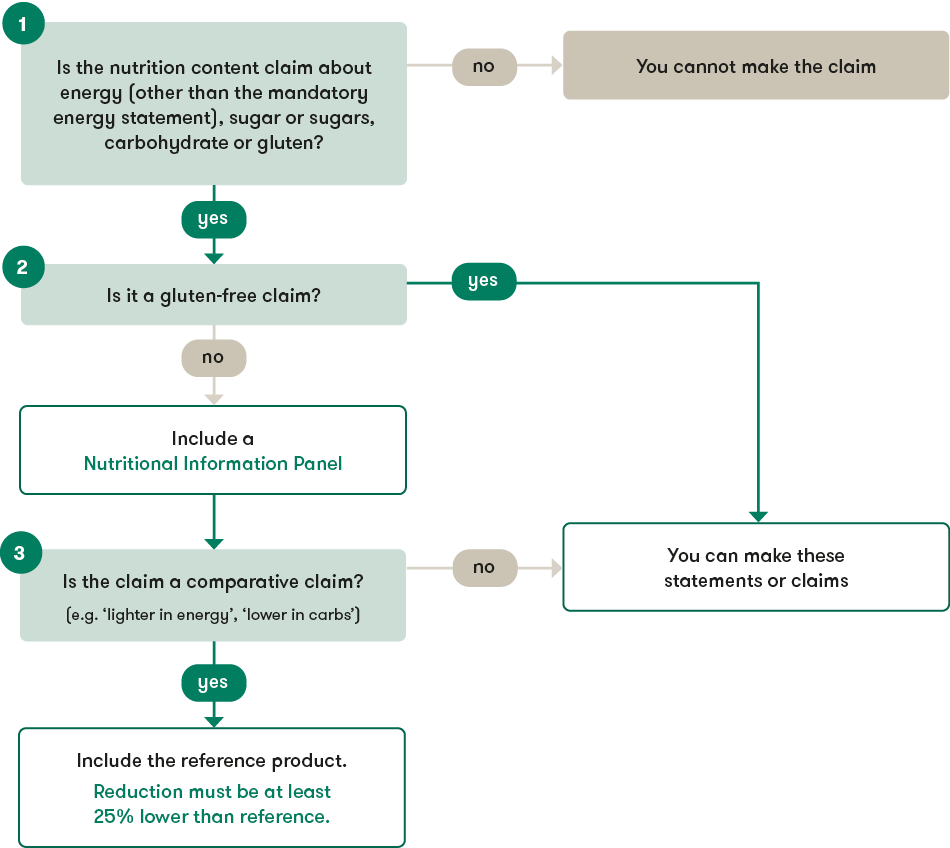
Gluten-free claims do not trigger a NIP requirement. Claims about individual sugars, such as fructose, or other specific components of carbohydrate are not permitted.
Comparative nutrition content claims, such as “lighter in energy”, must identify a reference product and demonstrate a difference of at least 25%. For example: “Lighter in energy wine – at least 25% less energy compared to [2025 Brand Shiraz]”.
This flow chart can be used to assess whether nutrition content claims for energy (other than the mandatory energy statement), sugar or sugars, carbohydrate, or gluten comply with the Food Standards Code.
Representations of light, low and no alcohol ( 2.7.1)
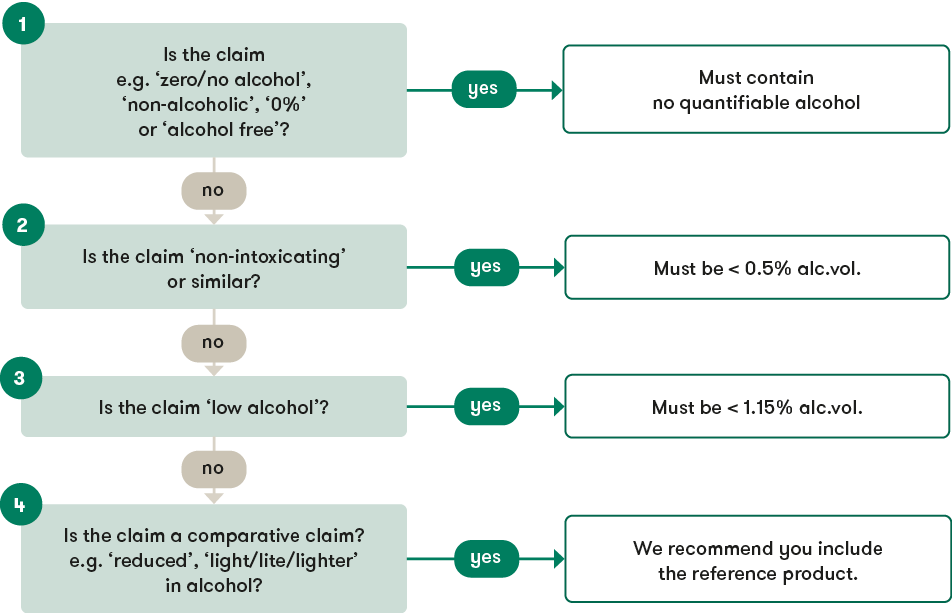
Any alcoholic beverage containing more than 1.15% alcohol by volume must not be represented as a ‘low alcohol’ beverage.
Similarly, the label on a package of a beverage containing more than 0.5% alcohol by volume must not include the words ‘non intoxicating’ or words of similar meaning.
Food containing alcohol must not be represented in a form which expressly or by implication suggests that the product is a non-alcoholic beverage e.g. ‘zero alcohol’ or ‘no alcohol’. As test reports rarely quote zero you should be able to support a zero/no alcohol claim with a report quoting the alcohol as less than the limit of quantification (LOQ).
It should be highlighted that terms such as ‘zero’ are not defined. Rather it is the implication or overall impression given on the label that a product contains no alcohol. For example, the word ‘zero’ used in conjunction with other mitigating information such as ‘contains less than 0.5% alcohol’ would remove the implication that the product is a non-alcoholic beverage.
The term ‘light’ is not defined in the Food Standards Code. A claim such as ‘light alcohol’ is not considered a nutrition content claim, however, would likely be considered a comparative claim. Accordingly, Wine Australia recommends the label indicate the identity of the reference food and the difference between the amount of the claimed food and referenced food e.g. ‘Lighter in alcohol wine – at least xx% lighter in alcohol compared to [2020 brand Shiraz].
This flow chart will help determine whether your claim meets the requirements.
Note, grape-based products that contain alcohol require export approval from Wine Australia
Australian Consumer Law
Any product sold in Australia is subject to the Australian Consumer Law, which prohibits conduct in trade or commerce which is misleading or deceptive or likely to mislead or deceive. Refer to the ACCC’s guidance on making premium claims and environmental claims. In short, any claims must be honest, accurate and able to be substantiated.
Certain wine label claims that would come under these provisions include statements such as ‘single vineyard’, ‘barrel fermented’, ‘estate bottled’, ‘established in xxxx’ etc.