


The following items are optional on wine labels for sale in Australia and/or New Zealand
Amber/Skin contact wine
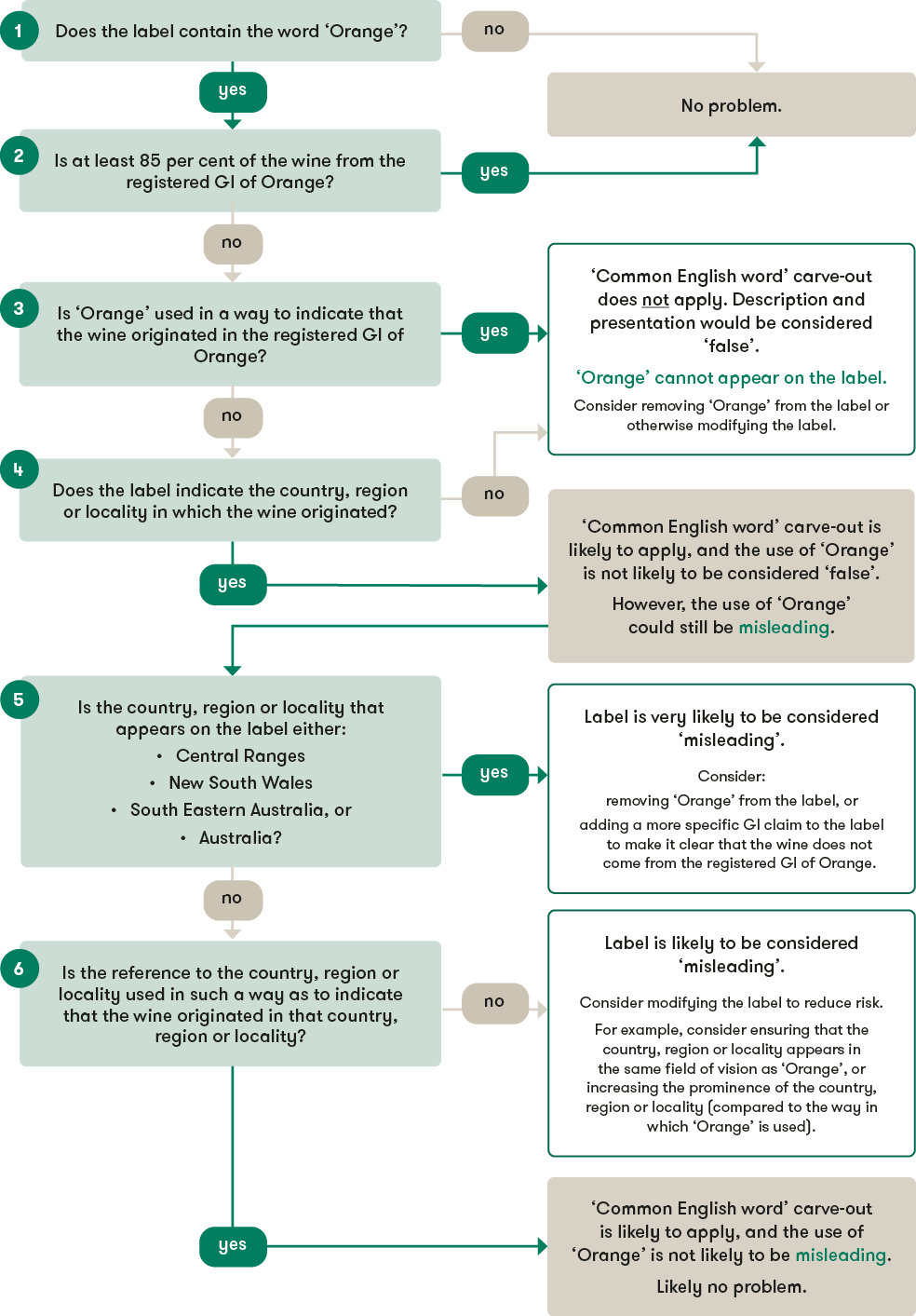
Orange became a registered geographical indication on 31 October 1997, and as such, is afforded the same level of protection as all other registered GIs. Therefore, generally, the term ‘orange wine’ cannot be used to describe skin contact white wines, unless the fruit has been sourced from the registered GI, Orange.
An exemption from the false and misleading description and presentation provisions exists to allow for the use of a ‘common English word’, which orange would qualify for. However, it must be used in good faith, and in such a way that is not likely to mislead as to the origin of the wine. To make it abundantly clear to the consumer that orange is being used to describe colour there must be sufficient context to support the claim, i.e. ‘Wine with an orange hue’ or ‘orange in colour’. Alternatively, ‘amber’ is an acceptable replacement for orange when presenting or describing skin contact white wines, or wines that are amber in colour.
If you want to use the word orange on a wine label, this flow chart will help determine whether your proposed use is compliant.
Apera and Topaque
When the Australia–EU Wine Agreement took effect on 1 September 2010, Australia agreed to discontinue the use of several protected European wine terms, including Sherry and Tokay, in exchange for improved market access. To replace Sherry, which has been protected since 1 September 2011, the Australian wine sector developed the term Apera. The term Tokay was phased out on 1 September 2020 and replaced with Topaque. Both Apera and Topaque are registered certification trade marks owned by Wine Australia and may be used only by approved users. Use of these terms is subject to conditions including, but not limited to, the following:
Apera
the term may only be used to describe Australian fortified wines
the fortified wine must comply with the taste, aroma and characteristics of an Apera wine referred to in the Australian Wine Industry Fortified Wine Code of Practice
the term must appear on the label in the same field of vision as the producer’s distinguishing trade mark, and
the term must always appear with a font size equal to or less than 50 per cent of the size of the distinguishing trade mark.
Topaque
the term may only be used for Australian fortified wines produced exclusively from grapes harvested in Australia and at least 850ml/L of which must be obtained from vine variety Muscadelle, and
the fortified wine must comply with the Australian Wine Industry Fortified Wine Code of Practice.
If you wish to use either term on your label, contact us.
Bar codes
Bar codes are not required by the Food Standards Code or regulated as to size or placement. They are, however, increasingly required by wholesalers and retailers in Australia and overseas. The 13-digit EAN (European Article Number) is the most commonly used in Australia and the EU and the only one now accepted in Canada. The USA accepts both EAN and the 12-digit UPC (Universal Product Code). The EAN system can read UPC, but the reverse does not apply. For further information regarding either system contact GS1 Australia.
In certain states and territories, CDS container approvals require a unique barcode. For more information, refer to Container Deposit Schemes.
Brand names
Brand names (or any other name) should not mislead as to the origin, age or identity of the wine. If a brand name (or business name) contains a registered GI it can only be used on the label when the wine has been sourced from the relevant GI.
Regulation 32 of the Regulations allows for the co-existence of Australian GIs and trade marks which were registered by IP Australia prior to the registration of the GI.
Cabernets
The term ‘Cabernets’ was adopted by the Australian wine industry to replace the term ‘Bordeaux’ which was listed on the Register as a protected GI in 1994. Not to be confused with the varietal claim ‘Cabernet’, which is a synonym for Cabernet Sauvignon, the term ‘Cabernets’ may be used in the description and presentation of a wine in place of a varietal claim to indicate one of two types of blends:
a blend comprising at least 85% Cabernet Sauvignon, Cabernet Franc and/or Ruby Cabernet, or
a blend comprising at least 85% of traditional ‘Bordeaux’ varietals (Cabernet Sauvignon, Cabernet Franc, Merlot, Malbec and/or Petit Verdot) provided that at least one of Cabernet Sauvignon or Cabernet Franc contribute to the blend.
The context in which the term ‘Cabernets’ is being claimed must be clearly indicated on the label.
Carbon neutral and sustainability claims
Wine Australia has developed a guide to help Australian grape and wine businesses convey their sustainability achievements, targets and actions in an authentic manner that builds trust in their products or labels and engages staff and customers.
Carbon neutral claims are used to convey a message about the volume of carbon emissions associated with a particular thing, most often a product or an organisation. If a wine or a winery claims to be ‘carbon neutral’, then the net emissions associated with that wine or winery must be zero. Carbon neutral claims must comply with the Australian Consumer Law. This means that they must not be false, misleading or deceptive. Care should be taken when using broad terms that are capable of multiple meanings – for example: ‘green’, ‘carbon friendly’, ‘carbon compensated’ and ‘environmentally safe’.
Wine Australia has developed a Carbon Neutral document which includes details on the Climate Active Carbon Neutral Standards administered by the Department of Environment and Energy and links to the Australian Association of National Advertisers Environmental Claims Code.
Carton labelling
The National Trade Measurement Regulations 2009 (Cth) requires that if a pre-packaged product is packed or sold, the package containing the product must be marked with the name and address of the person who packed the product or on whose behalf it was packed. The carton must indicate either the total volume of the inner packages or the number of packages and the volume of each (e.g. 12 x 750 mL).
If products are offered for sale to consumers in the carton as a consumer unit (e.g. a three-bottle presentation pack) the Food Standards Code requires that all mandatory information for a wine label be reproduced (or the information be visible on the inner packages) on the outer carton.
If the outer packaging, such as a carton, is not used for retail sale and is only used for transportation and distribution purposes, full labelling with mandatory information (including the pregnancy warning logo) is not required. If the carton is intended to be removed prior to retail sale, only the product name, lot identification, supplier details and quantity statement (e.g. quantity in carton × volume of product) are required.
Cleanskins (unlabelled wine)
It is not legal to sell or export wine without all mandatory items appearing on the packaging. Unlabelled bottles cannot be sold at retail to the public, but unbroken cartons of bottles can be sold if the mandatory information appears on the carton in an acceptable form. However, mandatory warning declarations including allergens and the pregnancy warning must still appear on every bottle.
Dates on labels
Care should be taken when using historical dates or additional numeric references in the description and presentation of a wine to avoid misleading as to the vintage of the wine. Other years may be referred to on wine labels, for example, to indicate when the winery was established, when a vineyard was planted, or when the winemaker joined the winery. When such references are made, it’s important to make sure that they won’t be interpreted as vintage claims.
To ensure references to a year that isn’t a vintage year is permissible, you should:
- give context to the non-vintage year (for example, use words like ‘planted in’, ‘established in’ or ‘produced since’)
- ensure the actual vintage claim is clearly stated
- ensure the actual vintage claim appears in the same field of vision as the reference to the other year, and
- ensure the actual vintage claim is more prominent than the reference to the other year.
Display of awards and medals
The use of medals or awards in the description and presentation of wines is permitted, however care should be taken that they do not clash with any other labelling consideration (such as use of a protected term). The Australian wine sector has developed a Display of Awards Code of Practice which outlines how awards should be displayed. This Code of Practice is available from the AGW website Medal display
Fortified wine terms
A number of fortified wine terms are protected on the Register. It is an offence under the Act to include a registered term in the description and presentation of a wine that does not comply with the registered conditions of use applicable to that term. Refer to the Australian Wine Industry Fortified Wine Code of Practice for further information. The protected terms and their conditions of use are outlined in the table below.
| Term | Description |
|---|---|
Cream | Describes a style of Australian fortified sweet wine of not less than 5 baumé. The wine will be pale yellow to light amber in colour, rich and sweet to taste and typically with a vinous to fruity aroma. The wine can be blended from more than one vintage and typically does not exhibit age-derived characters. Ageing takes place in a variety of vessels. Fortification must be from Australian grape spirit. In addition, for the export market, the wine will be produced using the solera system, including being aged in oak barrels for at least three years. |
Crusted/Crusting | Describes a fortified wine in which deposits may develop in the bottle. |
Ruby | Describes a style of Australian fortified wine that receives only a few years of ageing prior to bottling. At bottling the wine retains a deep ruby colour and tends to be robust in character, full bodied and fruity. The wine can be blended from more than one vintage, with a view to sustaining the primary characteristics of colour and aroma. Fortification must be from grape spirit. In addition, for the export market, the ageing of the wine will include, as a minimum, ageing in oak barrels for four months. |
Solera | Describes a system of using casks/barrels containing wines of varying ages. The wines from the barrel containing the oldest mix of vintages is taken from the solera. All of the wines in the barrels of the solera then cascade in order of age and the barrel containing the youngest mix of wines refreshed with new wine. The process gives a blended product, ranging from pale straw to a dark amber colour depending on the style being produced. This process is reserved for the production of fortified wines. |
Tawny | Describes a style of Australian fortified wine that receives varying years of ageing prior to bottling. At bottling the wine has a red-gold or ‘tawny’ hue. The wines should reflect the characteristics of careful aging showing ‘developed’ rather than ‘fresh’ fruit characters. However, many show the fresh well developed ‘fruit’ characteristics of younger wine. The wine is usually blended from more than one vintage, may be matured in oak containers and reaches an optimal age before sale. Fortification must be from grape spirit. |
Vintage | Describes a style of Australian fortified wine that is produced from a single vintage year. These high quality wines are characterised by relatively long periods of bottle maturation. They are generally deep in colour, full bodied and smooth. They are entitled to bear the designation ‘vintage’ and the corresponding year. These wines are characterised by the ability to improve with age in bottle and benefit from prolonged cellaring. Such wines are aged for a minimum of twenty months prior to release. Fortification must be from Australian grape spirit. In addition, for the export market, the ageing of the wine will include, as a minimum, ageing in oak barrels for four months. |